
German Grammar The Foundation of Fluency and Clear Communication
German is one of Europe’s most powerful languages in education, business, research, and technology. But what truly determines success in German is not just vocabulary — it is grammar.
German grammar may seem complex at first, but once understood, it becomes a logical system that allows you to speak, write, and understand the language with confidence and precision. Mastering grammar doesn’t just help you pass exams — it opens doors to careers, higher education, and cultural integration in German-speaking countries.
Why German GrammarMatters So Much
Many learners try to memorize words quickly and start speaking immediately. But without grammar, communication breaks down.
German grammar provides:
✅ Structure
Grammar tells us how words connect. Without structure, sentences become confusing.
Incorrect: Ich Hund sehen.
Correct: Ich sehe den Hund. (I see the dog.)
✅ Clarity
German uses cases and endings to show relationships between words. This avoids misunderstandings.
✅ Precision
In academic and professional settings, grammar determines how clearly ideas are conveyed. In exams, grammar accuracy directly impacts scores.
✅ Fluency
Fluency is not just speed — it is speaking correctly without thinking about rules. Grammar practice builds this instinct.

Core Features of German Grammar
German grammar is systematic. Once you understand its key components, the language becomes predictable.
1. Noun Gender – The First Challenge
Every German noun has a gender:
| Gender | Article | Example | Meaning |
|---|---|---|---|
|
Masculine |
der |
der Mann |
the man |
|
Feminine |
die |
die Frau |
the woman |
|
Neuter |
das |
das Kind |
the child |
Gender affects:
Articles
Adjectives
Pronouns
Unlike English, gender often must be memorized. However, patterns exist:
-ung, -keit, -heit → usually feminine
-chen, -lein → neuter
2. The Four Cases — The Heart of German Grammar
German changes articles and adjectives depending on their role in the sentence.
| Case | Function | Question | Example |
|---|---|---|---|
|
Nominative |
Subject |
Who? |
Der Hund schläft |
|
Accusative |
Direct object |
Whom? |
Ich sehe den Hund |
|
Dative |
Indirect object |
To whom? |
Ich gebe dem Hund Futter |
|
Genitive |
Possession |
Whose? |
Das ist das Spielzeug des Hundes |
Cases allow German to have flexible word order while maintaining meaning.
3. Articles Change with Case
| Case | Masculine | Feminine | Neuter |
|---|---|---|---|
|
Nominative |
der |
die |
das |
|
Accusative |
den |
die |
das |
|
Dative |
dem |
der |
dem |
|
Genitive |
des |
der |
des |
Example:
Der Hund beißt. (subject)
Ich sehe den Hund. (object)
4. Adjective Endings
| Case | Masculine |
|---|---|
|
Nominative |
Ein großer Hund |
|
Accusative |
Einen großen Hund |
These endings show grammatical relationships clearly.
5. Verb Conjugation
German verbs change depending on:
Person
Tense
Mood
Example with machen (to do):
| Person | Conjugation |
|---|---|
|
Ich |
mache |
|
Du |
machst |
|
Er/Sie/Es |
macht |
|
Wir |
machen |
|
Ihr |
macht |
|
Sie |
machen |
6. Separable Verbs
A unique feature of German:
aufstehen (to get up) Ich stehe um 7 Uhr auf.
The prefix moves to the end in present tense sentences.
7. Word Order Rules
German word order follows strict logic.
Main Clause:
Verb is always in position 2
Ich lerne heute Deutsch.
Heute lerne ich Deutsch.
Subordinate Clause:
Verb goes to the end
Ich weiß, dass er Deutsch lernt.
8. Time–Manner–Place Rule
German sentence order often follows:
Time → Manner → Place
Ich gehe heute mit dem Bus zur Schule.
Why Grammar Is Crucial for Career and Study
Mastering grammar is not just academic — it is practical.
For Students
-
Required for B1/B2 exams
-
Needed for university admission
-
Helps in academic writing
For Professionals
Germany leads in:
-
Engineering
-
IT
-
Automotive
-
Research
Correct grammar is essential for workplace communication.
For Integration
Grammar helps in:
-
Visa interviews
-
Social interactions
-
Understanding official documents
Common Grammar Difficulties
Learners often struggle with:
Case endings
Gender memorization
Verb position
Separable verbs
These challenges are normal and become easier with structured practice.
Best Way to Learn German Grammar
1️⃣ Start with basics
Learn sein, haben, and present tense.
2️⃣ Practice cases daily
Make simple sentences:
-
Ich sehe den Mann
-
Ich gebe dem Mann das Buch
3️⃣ Speak aloud
Grammar becomes natural through speaking.
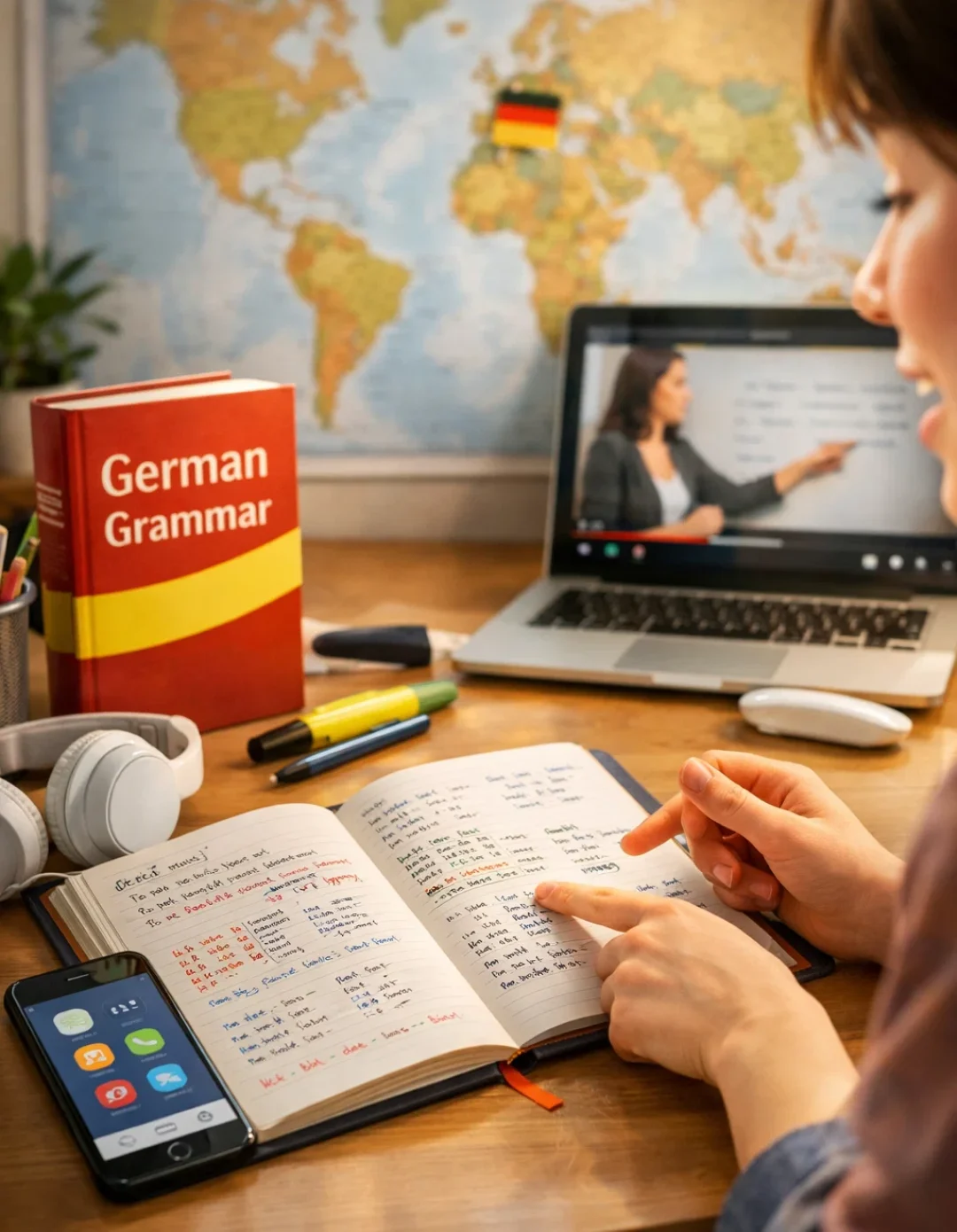
4️⃣ Use apps + books
Apps build habit; grammar books build understanding.
5️⃣ Listen to German
Podcasts and videos help you hear grammar in action.
From Rules to Fluency
At first, grammar feels like memorization. But with repetition:
Rule → Pattern → Habit → Fluency
Eventually, you don’t think — you just speak correctly.
Final Thoughts
German grammar is not a barrier — it is the key to mastering the language. It transforms scattered words into meaningful communication.
Whether your goal is:
Studying in Germany
Building a career
Passing language exams
Connecting with culture
Grammar is your foundation.
Learn it step by step, practice daily, and fluency will follow.